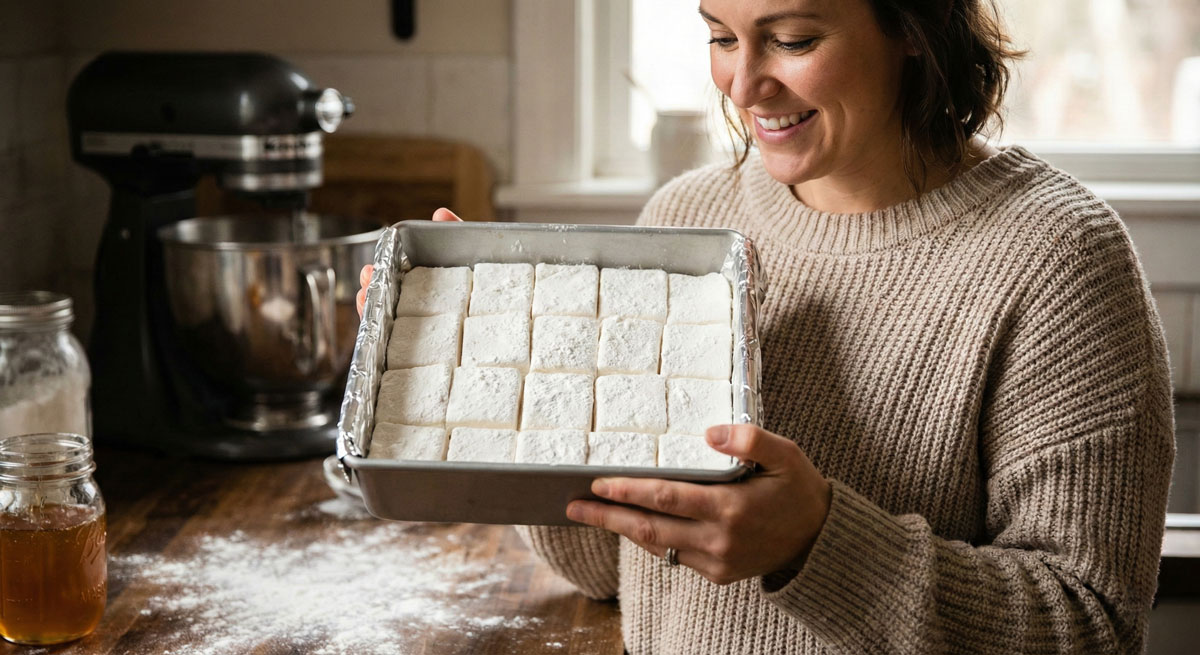
Why You’ll Love These Homemade Marshmallows
Making homemade marshmallows might seem intimidating because of the candy thermometer, but I promise it is simpler than it looks. Unlike the rubbery versions from the grocery store, these homemade marshmallows are light as air. Plus, because we use tapioca flour for dusting, they have a beautiful, professional finish that makes them a gorgeous gift for friends and family.
Tips for Perfect Homemade Marshmallows Every Time
The key to success with homemade marshmallows is the "soft ball" stage. You want to hit that sweet spot of $242^\circ\text{F}$ to ensure they set properly. If you are looking for more homemade marshmallows inspiration, remember that you can easily swap the vanilla for peppermint or almond extract to change the flavor profile!
Ingredients
- 1.0 cup (236g) filtered water, divided into two equal 0.5 cup (118g) portions
- 3.0 tbsp (27g) grass-fed beef gelatin
- 1.0 cup (340g) organic honey
- 1.0 tsp (4g) vanilla extract
- 0.25 tsp (1.5g) fine sea salt
- 1.0 tbsp (14g) coconut oil (for greasing)
- 0.25 cup (32g) tapioca flour (for dusting)
Preparation Instructions
- Prepare an 8x8 inch (20cm) square baking pan by creating a foil sling with two perpendicular strips of aluminum foil, then grease the surface with coconut oil and dust lightly with a thin layer of tapioca flour.
- Combine 3.0 tbsp (27g) of gelatin and the first 0.5 cup (118g) of water in the bowl of a stand mixer and let it bloom while you prepare the syrup.
- Mix the remaining 0.5 cup (118g) of water, 1.0 cup (340g) of honey, and 0.25 tsp (1.5g) of salt in a medium saucepan over medium heat and bring the mixture to a rolling boil.
- Monitor the syrup with a candy thermometer until it reaches exactly 242°F (117°C), ensuring you do not exceed 245°F (118°C) to maintain the soft-ball stage.
- Remove the saucepan from the heat immediately at the target temperature and set your stand mixer to low-medium speed to break up the bloomed gelatin.
- Pour the hot honey syrup in a very slow, steady stream down the inner side of the mixer bowl to prevent "breaking" the gelatin, which ensures the homemade marshmallows stabilize correctly.
- Increase the mixer speed to high once all syrup is incorporated and beat for 7.0 to 10.0 minutes until the mixture becomes thick, white, and opaque like marshmallow crème.
- Incorporate 1.0 tsp (4g) of vanilla extract during the final 60 seconds of the whipping process to preserve the flavor.
- Transfer the aerated mixture into the prepared pan immediately using a greased spatula and smooth the surface into an even layer.
- Allow the homemade marshmallows to cure at room temperature for a minimum of 4.0 to 6.0 hours (or overnight) to ensure they are firm enough for clean slicing.
- Lift the block out using the foil sling, dust your knife with extra tapioca flour, and cut into 1-inch squares, tossing each piece in additional tapioca flour to prevent sticking.
- Store your finished homemade marshmallows in an airtight container in the refrigerator for up to 7 days, or leave them out covered with cheesecloth overnight if you plan to roast them.
Nutritional Information
Based on 16 servings (1 square per serving):
- Calories: 72 kcal
- Carbs: 18.5g
- Protein: 1.8g
- Fat: 0.5g
Pro Tips for Success
- Temperature is King: Use a high-quality digital candy thermometer. Even a 2-degree difference can change the texture of your homemade marshmallows from soft clouds to chewy taffy.
- The "Slow Stream" Technique: When pouring the hot honey into the mixer, aim for the space between the whisk and the side of the bowl. If it hits the whisk, it will splatter; if it hits the gelatin too fast, it can "break" the proteins.
- Grease Your Tools: Marshmallow crème is incredibly sticky. Rub a little coconut oil on your spatula and even your knife before cutting to make the process mess-free.
- Patience Pays Off: Resisting the urge to cut the marshmallows early is hard, but waiting at least 4 hours ensures the internal structure has fully set, giving you those perfect, sharp edges.
Frequently Asked Questions (FAQ)
Can I substitute the honey with maple syrup in this recipe? Yes, you can substitute maple syrup for honey 1:1. Keep in mind that maple syrup reaches the soft-ball stage slightly faster, so keep a close eye on your thermometer to ensure your homemade marshmallows set correctly.
Why did my marshmallows turn out grainy? Graininess usually happens if the honey mixture is stirred too much while boiling, causing sugar crystals to form. To prevent this, let the honey and water come to a boil naturally and only use a spoon to gently break up any foam on the surface.
How do I get my marshmallows to brown perfectly when roasting? The secret is the tapioca flour coating. Unlike cornstarch, tapioca flour aids in the browning process. For the best "toasted" effect, let your homemade marshmallows sit out overnight covered in cheesecloth to develop a very thin "skin" before roasting over a flame.
Are these marshmallows shelf-stable? Because these are made with honey and gelatin without preservatives, they are best stored in the refrigerator in an airtight container. They will stay fresh and fluffy for about 5 to 7 days.
Conclusion
Ready to elevate your snack game? These homemade marshmallows are the perfect project for anyone looking to enjoy paleo marshmallows that are actually good for you. By using grass-fed gelatin and refined sugar free ingredients, you can satisfy your sweet tooth while keeping your ingredients clean. Whether you're making a batch for soft ball stage candy practice or just want the ultimate healthy marshmallow recipe for your winter cocoa, this guide has you covered. Give these honey marshmallows a try this weekend and experience the difference that real ingredients make!