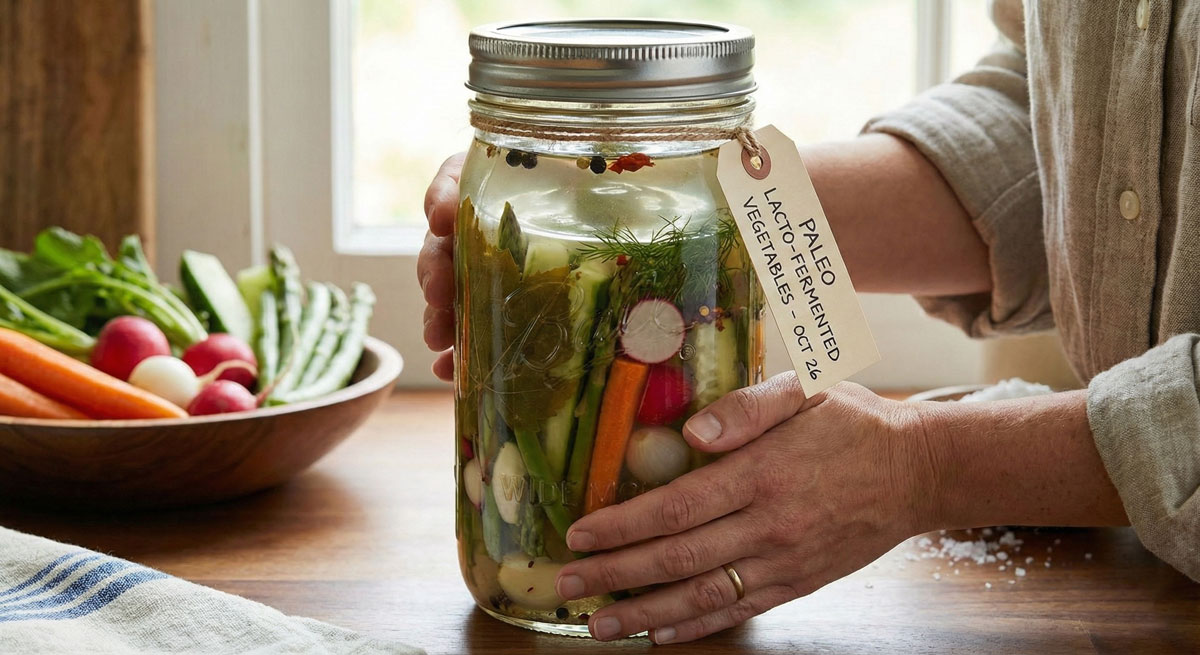
You guys know I’m all about keeping things simple but nutritious, especially when it comes to maintaining a healthy gut. If you’ve been looking for a crunchy, tangy snack that fits perfectly into your Paleo, Keto, or Vegetarian lifestyle, you are going to love this. These Lacto-Fermented Vegetables are way better than anything you buy at the store—they’re loaded with natural probiotics, super easy to prep, and honestly, they just taste fresher. Grab a mason jar, and let’s get fermenting!
Yields: 1.0 Quart Jar Prep time: 0.5 hours Fermentation time: 10.0 days (minimum)
Ingredients
-
1.5 to 2.0 lbs (24.0 oz to 32.0 oz / 680.0 g to 907.0 g) Seasonal Garden Vegetables (such as cucumbers, carrots, asparagus, green beans, or radishes)
-
1.0 quart (4.0 cups / 32.0 fl oz / 946.0 ml) Filtered Water
-
2.0 tbsp (approx. 1.2 oz / 34.0 g) Sea Salt
-
Note: If your kitchen temperature is consistently above 85°F (29°C), reduce salt to 1.0 tbsp (0.6 oz / 17.0 g).
-
-
1.0 to 2.0 tbsp (0.2 oz to 0.5 oz / 6.0 g to 14.0 g) Pickling Spices (such as mustard seeds, peppercorns, coriander seeds, or dill seeds)
-
2.0 to 4.0 cloves Fresh Garlic, peeled and slightly crushed
-
1.0 to 2.0 units Tannin-rich Leaves for crispness (fresh grape, horseradish, oak, mesquite, or even dried black tea leaves)
-
0.25 to 0.5 medium Onion, sliced (optional)
-
2.0 to 3.0 sprigs Fresh Herbs (dill, thyme, or oregano)
Preparation Instructions
- Prepare the Brine: In a pitcher or bowl, combine 1.0 quart (4.0 cups) of water with 2.0 tbsp (1.2 oz / 34.0 g) of sea salt. Stir vigorously until the salt has completely dissolved. Set this liquid aside. Remember to check your room temperature; if it is extremely hot (over 85°F), use only 1.0 tbsp of salt.
- Prepare the Vegetables: Wash your vegetables thoroughly. Chop them into sticks, spears, or bite-sized chunks depending on the vegetable type. Ensure pieces are small enough to fit comfortably inside the jar but substantial enough to stay submerged.
- Layer the Flavorings: In a clean, sterilized 1.0 quart glass jar, place the aromatics at the very bottom. Add the 2.0 to 4.0 cloves of garlic, the 1.0 to 2.0 tbsp of pickling spices, the sliced onion (if using), and fresh herbs.
- Add Crisping Leaves: Place the 1.0 to 2.0 units of tannin-rich leaves (grape, oak, etc.) on top of the spices. These leaves contain tannins that prevent the vegetables from becoming mushy during fermentation.
- Pack the Vegetables: Pack the chopped vegetables tightly into the jar on top of the flavorings. Leave at least 2.0 inches (5.0 cm) of headspace between the top of the vegetables and the rim of the jar.
- Add the Brine: Pour the prepared salt water brine over the vegetables. Ensure the vegetables are submerged by at least 1.0 inch (2.5 cm) of liquid. If you have a larger jar, 2.0 to 4.0 inches of brine coverage is ideal.
- Weight Down: Place a fermentation weight on top of the vegetables to keep them submerged beneath the anaerobic brine. You can use a glass fermentation weight, a small ceramic plate, a cabbage leaf tucked down the sides, or a slice of root vegetable.
- Fermentation: Seal the jar tightly with a lid. Place the jar in a location out of direct sunlight with a temperature range of 65°F to 85°F (18°C to 29°C). Allow the mixture to ferment for 10.0 days or longer.
- Maintenance (Burping): During the first 3.0 to 5.0 days, carbon dioxide will build up inside the jar. Check the lid daily. If it feels tight or bulging, briefly unscrew the lid to release the gas (“burping”) and immediately screw it back on tightly.
- Storage: After 10.0 days, taste the vegetables. If they have reached your desired level of sourness, move the jar to cold storage. This can be a root cellar, basement, or refrigerator kept below 65°F (18°C). The fermentation will slow down significantly, and the pickles will keep for several months.
Nutritional Information
Serving Size: 2.0 oz (approx. 56.0 g or 0.25 cup) Servings Per Container: approx. 16.0
-
Calories: 12.0 kcal
-
Total Fat: 0.0 g
-
Saturated Fat: 0.0 g
-
Cholesterol: 0.0 mg
-
Sodium: 280.0 mg to 320.0 mg (Depending on how much brine is absorbed)
-
Total Carbohydrates: 2.5 g
-
Dietary Fiber: 1.1 g
-
Total Sugars: 1.0 g
-
Net Carbohydrates: 1.4 g
-
Protein: 0.5 g
-
Potassium: 85.0 mg
Pro Tips for Perfect Lacto-Fermentation
-
The “Chlorine” Rule: The most common reason fermentation fails is the water. Municipal tap water often contains chlorine or chloramine, which kills the beneficial bacteria you are trying to grow. Always use filtered, distilled, or spring water. If you only have tap water, boil it for 15.0 to 20.0 minutes and let it cool completely to evaporate the chlorine.
-
Salt Matters: Do not use standard table salt containing iodine or anti-caking agents, as these can inhibit fermentation and cloud the brine. Stick to the 2.0 tbsp of pure sea salt, Kosher salt, or pink Himalayan salt as listed in the recipe.
-
The “Ice Bath” Trick: For extra crunch, soak your cucumber spears or vegetable sticks in a bowl of ice water for 0.5 to 1.0 hour before packing them into the jar. This tightens the cell structure and helps prevent mushiness.
-
DIY Fermentation Weights: If you don’t own glass fermentation weights, you can use a small Ziploc bag. Fill the bag with a brine solution (use a ratio of 1.0 tsp salt to 1.0 cup water), seal it, and place it on top of the vegetables. If the bag leaks, it won’t dilute your ferment because the liquid inside is also salty brine.
-
Kahm Yeast vs. Mold: You might see a thin, white, powdery film form on the surface of the brine. This is usually “Kahm yeast,” which is harmless but can affect the flavor if left too long. Simply skim it off. However, if you see fuzzy patches that are blue, green, or black, that is mold. In that case, discard the entire content of the jar to be safe.
-
Temperature Control: Fermentation moves faster in warmer weather. At 75°F (24°C), your vegetables might be ready in 5.0 to 7.0 days. At 60°F (15°C), it could take up to 3.0 weeks. Taste test a small piece using a clean fork starting on day 5.0 to catch the flavor peak you prefer.
Frequently Asked Questions
What is the difference between lacto-fermented vegetables and vinegar pickles? The main difference is the preservation method. Store-bought pickles are usually preserved with hot vinegar, which kills bacteria. Lacto-fermented vegetables use a salt water brine to encourage the growth of Lactobacillus, a beneficial bacteria. This process creates natural lactic acid, which preserves the vegetables and creates a tangy flavor without any added vinegar. This makes them a probiotic-rich “live” food.
Is it safe to eat fermented vegetables if the brine turns cloudy? Yes, absolutely. A cloudy brine is actually a good sign! It indicates that the lactic acid bacteria are active and multiplying. The cloudiness usually appears around day 3.0 to 5.0 of fermentation. However, if the brine becomes slimy or smells like rotten eggs, you should discard the batch.
Can I use table salt instead of sea salt for fermentation? It is not recommended. Standard table salt often contains iodine and anti-caking agents. Iodine can inhibit the growth of the beneficial bacteria needed for fermentation, and anti-caking agents can turn your brine a murky, unappealing color. For the best results, stick to the 2.0 tbsp of pure sea salt or pink Himalayan salt listed in the recipe.
How long do lacto-fermented vegetables last in the refrigerator? Once you move your jar to cold storage (below 65°F or 18°C), the fermentation process slows down dramatically. If kept submerged in the brine, your vegetables will stay crunchy and safe to eat for 4.0 to 6.0 months. Always use a clean utensil to remove vegetables from the jar to prevent contamination.
Why are my fermented vegetables soft or mushy? Mushiness can happen for a few reasons: the room temperature was too high (above 85°F or 29°C), not enough salt was used, or the vegetables had high water content. To prevent this, add tannin-rich leaves (like grape or oak leaves) as described in the recipe, and consider using an ice bath soak for 1.0 hour before packing the jar.
Is this recipe suitable for a Keto or Paleo diet? Yes. Since the fermentation bacteria consume the natural sugars found in the vegetables, the final carbohydrate count is very low—approximately 1.4 g of net carbs per serving. This makes lacto-fermented vegetables an excellent, gut-healthy snack for Keto, Paleo, and Whole30 diets.
Do I need an airlock lid to make fermented vegetables? No, you do not need expensive equipment. While an airlock lid makes the process easier by automatically venting gas, you can use a standard mason jar lid. Just remember to “burp” the jar daily during the first 5.0 to 7.0 days by slightly unscrewing the lid to release built-up carbon dioxide pressure.
Conclusion
There you have it—a simple, foolproof way to turn your garden harvest into a gut-healing superfood. I know waiting 10.0 days for the fermentation magic to happen can feel like forever, but trust me, that perfect tangy crunch is totally worth the patience. Whether you stick to classic cucumbers or get adventurous with spicy radishes and garlic, these fermented veggies are a staple you will want in your fridge year-round. If you give this recipe a try, please drop a comment below and let me know which combination you picked. I would love to hear how your first batch turns out!