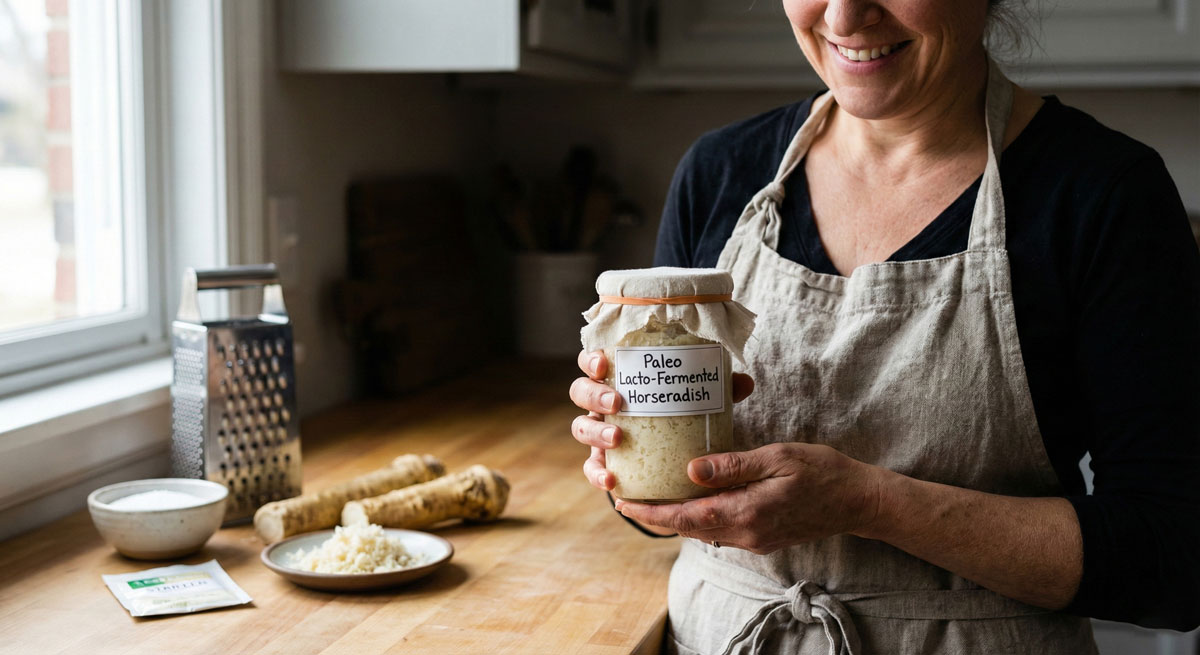
If you know me, you know I love adding a serious flavor kick to my meals, and this Paleo Lacto-Fermented Horseradish is my absolute favorite way to do it. Honestly, it tastes so much fresher than the store-bought stuff, and because it's fermented, it’s packed with natural probiotics to keep your gut health in check. Whether you're topping a roast or just love that spicy heat, this easy homemade recipe is a total game-changer for your Paleo kitchen!
Yields: Approximately 1.0 cup (8.0 fl oz / 240 ml)
Ingredients
-
1.0 cup (approx. 3.9 oz / 110.0 g) horseradish root, peeled and grated
-
1 packet (approx. 0.2 oz / 5.0 g) vegetable culture starter
-
1.5 tsp (approx. 0.3 oz / 9.0 g) sea salt
-
Filtered and sterile water, quantity as needed (approx. 0.25 to 0.5 cups)
Preparation
- Combine the 1.0 cup (110.0 g) of grated horseradish root, the vegetable culture starter packet, and the 1.5 tsp (9.0 g) of sea salt in a blender or food processor. Pulse a few times to thoroughly combine the dry ingredients.
- Add the filtered water, 1.0 tbsp (0.5 fl oz / 15 ml) at a time, pulsing the food processor or blender to incorporate after each addition. Add only enough water to create a thick paste; do not make it too runny.
- Transfer the horseradish paste into a sterilized glass jar. Add just enough extra water to completely fill the jar to the rim to exclude air.
- Place a loose-fitting lid over the top of the jar (do not seal it tight yet to allow gases to escape). Set the jar in a saucer to catch any overflow and store in a warm place for 3 to 7 days, or until the horseradish is completely fermented to your taste.
- Once fermented, seal the lid tightly and store in the refrigerator. It will keep for up to 6 months.
Chef’s Notes
-
Family Activity: If you have children, this is a great project to conduct with them to teach them about healthy bacteria and probiotics.
-
Sourcing: The vegetable starter can be acquired from a local health food store or online. A broad-range vegetable culture is recommended for multiple lacto-fermentation recipes.
Nutritional Information
Serving Size: 1.0 tbsp (approx. 0.5 oz / 15 g) Servings Per Recipe: 16
Amount Per Serving (1.0 tbsp)
-
Calories: 3.3 kcal
-
Total Fat: 0.1 g
-
Sodium: 225.0 mg
-
Total Carbohydrate: 0.8 g
-
Dietary Fiber: 0.2 g
-
Sugars: 0.5 g
-
-
Protein: 0.1 g
Amount Per Full Batch (1.0 cup)
-
Calories: 53.0 kcal
-
Total Fat: 0.8 g
-
Sodium: 3,600.0 mg
-
Total Carbohydrate: 12.4 g
-
Dietary Fiber: 3.6 g
-
Sugars: 8.8 g
-
-
Protein: 1.3 g
Note: Nutritional values are estimates based on the ingredients listed (110g horseradish root and 9g sea salt). Values may vary slightly depending on the specific brand of vegetable culture starter used.
Pro Tips for Perfect Fermented Horseradish
-
Watch Your Eyes (and Nose!): Fresh horseradish is incredibly potent. When you grate or blend the root, it releases volatile oils that can sting your eyes and clear your sinuses instantly. I highly recommend opening a window, turning on your kitchen fan, or even wearing kitchen goggles if you have sensitive eyes.
-
Chlorine is the Enemy: Since this is a live fermentation recipe, the quality of your water matters. Chlorine and chloramine found in tap water can kill the healthy bacteria in your vegetable culture starter. Always use filtered or distilled water to ensure your probiotics thrive.
-
Keep it Submerged: The golden rule of fermentation is "under the brine, everything's fine." Ensure your horseradish paste is completely covered by the liquid in the jar. If bits of horseradish are exposed to air, they are more likely to mold or turn brown.
-
The "Saucer" Trick: As the horseradish ferments, it releases carbon dioxide, which can cause the liquid to bubble up and seep out of the jar. Placing a saucer or small bowl underneath your jar during the 3–7 day counter sit will save your countertops from sticky puddles.
-
Taste Test: Fermentation speed depends on the temperature of your home (warmer homes ferment faster). Start tasting it after Day 3. Once it hits that perfect balance of tangy and spicy, seal it up and move it to the fridge to slow the process down.
Frequently Asked Questions
How long does homemade fermented horseradish last? Because this recipe uses lacto-fermentation, it has excellent keeping qualities. Once you move the jar to the refrigerator, it will stay fresh and potent for up to 6 months. Just make sure to use a clean spoon every time you dip into the jar to prevent contamination.
Is this recipe compatible with the Keto diet? Yes! Horseradish is naturally low in carbs. Since we are fermenting it without added sugar (unlike many store-bought sauces), this recipe is perfectly suitable for Keto, Paleo, and Whole30 meal plans.
Why do I need a vegetable culture starter? While you can ferment vegetables using just salt (wild fermentation), using a vegetable culture starter ensures a higher count of beneficial bacteria right from the start. This speeds up the fermentation process and provides a more consistent, probiotic-rich result that is better for gut health.
Is fermented horseradish milder than raw horseradish? Fermentation tends to mellow out the sharp, biting heat slightly, giving it a more complex, tangy flavor profile. However, it will still have that signature "kick" that clears your sinuses!
What dishes go best with fermented horseradish? This condiment is incredibly versatile. It pairs perfectly with roast beef, steak, and smoked salmon. It also adds a great zing to deviled eggs, salad dressings, or even mixed into mashed cauliflower for a spicy Paleo side dish.
Can I use whey instead of a vegetable starter? If you tolerate dairy, fresh whey (from dripping yogurt) can often work as a starter. However, to keep this recipe strictly Paleo and dairy-free, a vegetable culture starter is the best choice.
Making your own fermented foods might sound a little intimidating at first, but once you try this Paleo Lacto-Fermented Horseradish, you’ll see just how simple it really is. Not only do you get that unbeatable, fresh spicy kick that store-bought jars just can't match, but you’re also doing your body a huge favor with all those amazing probiotics. Give it a go, experiment with the fermentation time to find your perfect heat level, and let me know how it turns out! If you make this recipe, don’t forget to leave a star rating and drop a comment below—I’d love to hear how you’re serving it up.